PEP GUARDIOLA BREAKS SILENCE — CHERKI INCIDENT EXPLAINED Pep Guardiola has finally addressed the controversy surrounding Rayan Cherki after the heated moment in the EFL Cup Final against Arsenal F.C

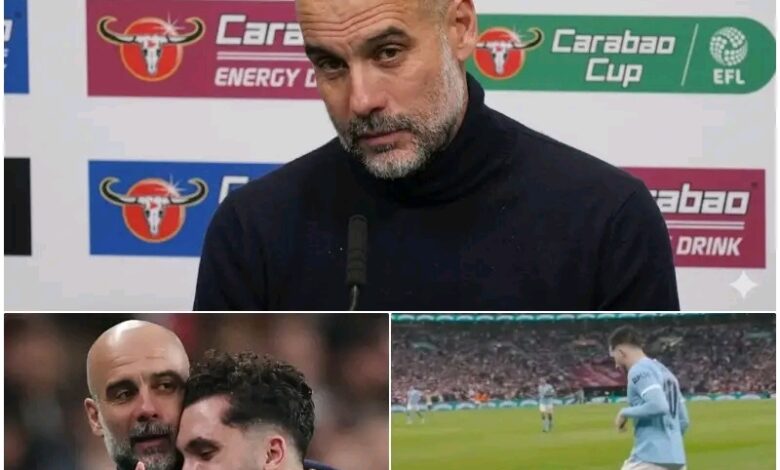
What was meant to be a straightforward occasion of triumph at the Carabao Cup Final instead became one of the most talked-about moments in recent football history — and it had nothing to do with what happened during the ninety minutes. Manchester City’s young French midfielder Rayan Cherki found himself at the centre of a firestorm after producing a series of flashy keepie-uppies directly in front of Arsenal’s dejected players at the final whistle, igniting an immediate and fierce global reaction.
**From Celebration to Controversy**
The footage spread almost instantly. Replays circulated across every platform within minutes, and the football public quickly took sides. While some were willing to chalk it up to the excitement of youth, the majority interpreted Cherki’s actions as a deliberate and disrespectful attempt to rub salt into Arsenal’s wounds at their lowest point of the evening.
**Ben White’s Response Goes Viral**
Arsenal centre-back Ben White was not prepared to let the moment pass without confrontation. He stormed towards Cherki, visibly furious, and the pair were involved in a brief but intense face-off that quickly became its own viral moment. Security personnel and teammates were forced to intervene before the situation could escalate further, but the footage had already been captured and distributed worldwide.
**The Online Storm**
The fallout on social media was enormous. Within hours of the final whistle, Cherki’s name was trending across more than forty countries. Every major platform was filled with reaction videos, opinion threads, and fan outrage. The overwhelming mood was one of condemnation — and it wasn’t just Arsenal supporters leading the charge. Fans from across the footballing world joined in, labelling the act as arrogant and unworthy of someone performing at the pinnacle of the professional game.
**Pundits Add to the Criticism**
Television analysts were equally unsparing. Across various post-match programmes, former professionals and studio guests queued up to take aim at the young Frenchman. The language used was consistently harsh — words like classless, immature, and disgraceful were thrown around with little hesitation. One notable former England international went so far as to describe it as the single worst display of sportsmanship he had witnessed at a cup final in two decades.
**The FA Opens a Review**
The controversy had grown large enough within a day that the Football Association confirmed it had launched an internal review of the incident. Officials had apparently been briefed and were formally studying the available footage. There was growing chatter that Cherki might face disciplinary consequences, potentially including a retrospective ban, if the review determined the act was intentionally provocative.
**Manchester City’s Silence — And Then Guardiola**
For the better part of the first day after the final, Manchester City offered no public response whatsoever. No club statement, no social media post, nothing. Many read this silence as embarrassment — a sign that the club was struggling to reconcile defending a high-profile new signing with distancing itself from behaviour that undermined its carefully managed public image. But on the second morning, Pep Guardiola sat down in front of the press and chose a very different path.
**What Guardiola Said**
Rather than deflecting or offering carefully worded non-answers, Guardiola was unexpectedly candid. He told those in the room that what they thought they had seen in that thirty-second clip bore little resemblance to the full picture of who Rayan Cherki actually was. He revealed that over the previous eighteen months, Cherki had been fighting a deeply private and painful psychological battle — one marked by severe self-doubt, an intense fear of failure, and a serious struggle with his mental health that had at certain points brought him to the verge of walking away from professional football altogether.
**The Year the Public Never Saw**
Guardiola described a young man who had arrived at Manchester City quietly carrying wounds that no highlight reel or performance statistic could ever convey. There were training sessions in which Cherki had barely been able to speak. There had been extended stretches where his confidence had disintegrated so thoroughly that even those coaching him had begun to question whether he would ever truly fulfil his potential. Far from being the cocky young provocateur the internet had constructed, Guardiola described someone who had been completely broken — and who was, for the first time, cautiously allowing himself to feel something resembling happiness.
**The Line That Stopped the Room**
The single quote that reframed the entire story came without warning or dramatic build-up. Guardiola said quietly that what people had watched on that pitch was not a boy taunting his opponents — it was a boy who had spent an entire year questioning whether he even had a place in the sport he loved, finally beginning to believe that he did. The press room fell into complete silence. Several journalists stopped mid-sentence.
**The Mood Shifts**
The effect was almost immediate. Within minutes of the press conference being aired, the tone across social media began to visibly soften. People who had posted furious condemnations started revising their words. Lengthy threads began emerging that traced Cherki’s difficult journey — his early rise at Lyon, the sudden collapse in form, the persistent transfer rumours, and the quiet doubts that had circulated within the game about his future.
**Even Arsenal Supporters Showed Empathy**
Perhaps most strikingly, voices of understanding began to surface even among Arsenal’s own fanbase. A post from one well-known Arsenal supporter account — acknowledging that the celebration still stung, but expressing genuine respect for Cherki if the fuller story was accurate — was liked over two hundred thousand times in just half a day. It was a small but telling indicator of how profoundly the context had altered the conversation.
**Cherki Speaks**
On the second evening after the final, Cherki himself posted a brief handwritten message to his Instagram. It had none of the polish of an official club statement — the writing was unpolished and the emotion entirely unfiltered. He expressed gratitude to Guardiola for speaking openly about his experiences, offered an apology to anyone genuinely hurt by his celebration, and then wrote the sentence that would be screenshotted and circulated millions of times across the internet: that he had smiled because he had survived, and simply hadn’t known any other way to show it.
**What It All Really Means**
Stripped back to its core, the Cherki story is not really about a cup final or a few seconds of ball-juggling. It is a story about how ruthlessly and swiftly public opinion can reduce a complex human being to a single decontextualised moment — and about what becomes possible when someone in a position of power decides to prioritise honesty over reputation management.
**Guardiola’s Bigger Victory**
Guardiola has accumulated virtually every honour the sport can bestow upon a manager. Yet many now argue that standing up publicly and unflinchingly for a young player’s humanity — at genuine risk to both his own standing and that of his club — may rank among the most meaningful things he has done in his entire career. His press conference posed a quietly devastating question to the football world at large: is the appetite for outrage greater than the appetite for truth?
**The FA’s Difficult Position**
The governing body’s review was still ongoing at the time of writing. Legal and disciplinary analysts have suggested that Guardiola’s public account of Cherki’s mental health struggles may complicate the path towards any formal sanction. The FA now finds itself in a genuinely delicate position — needing to uphold professional standards on the pitch without being seen to punish a player whose behaviour has since been widely reinterpreted as an expression of personal survival rather than deliberate misconduct.
**The Debate Continues**
The argument has not been fully resolved. There remain credible voices maintaining that personal circumstances cannot and should not excuse unprofessional conduct during a match — that the standards expected of elite footballers must apply regardless of what is happening behind closed doors. That is not an entirely unreasonable position. But it is no longer the dominant one. And in a world where public discourse rarely leaves room for nuance, that shift alone feels quietly significant.