Leeds United manager Daniel Farke was sent off after the final whistle for confronting referee Peter Bankes

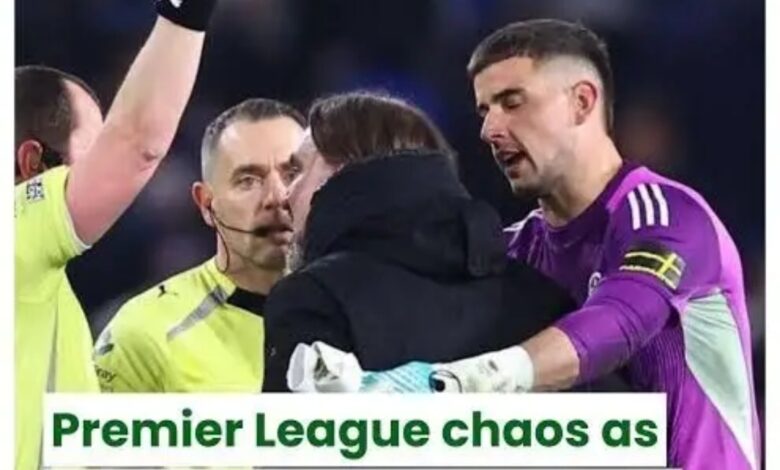
The night at Elland Road was already tense long before the final whistle blew. Leeds United were fighting with passion, Manchester City were battling for crucial points in the Premier League title race, and the atmosphere inside the stadium was electric. But when the match ended with a narrow Manchester City victory, the biggest talking point was not just the goal or the result. Instead, it was a moment during the game that left Leeds United manager Daniel Farke furious, frustrated, and openly accusing Manchester City of something serious.
According to Farke, the match included an incident that he believes disrupted Leeds United’s momentum at a critical moment. In his view, it was not simply a coincidence or an ordinary pause in play. He described it as something closer to “cheating,” a word that immediately caused debate among fans, pundits, and players across the Premier League.
The moment in question happened when Gianluigi Donnarumma, Manchester City’s goalkeeper, suddenly went down and requested medical treatment. On the surface, it looked like a routine stoppage. Players often receive treatment during matches. Goalkeepers especially may ask for attention when they feel discomfort, fatigue, or pain.
But the timing of this particular stoppage was what angered the Leeds bench.
At that moment in the game, Leeds United were building serious pressure. The team was pushing forward, pressing aggressively, and forcing Manchester City’s defenders into uncomfortable situations. The home crowd could sense something was coming. Elland Road was roaring with belief.
Every Leeds attack seemed to bring them closer to a breakthrough.
The midfield was working tirelessly to recover possession, and the forwards were closing down defenders quickly. The energy from the stands pushed the players even harder. Leeds looked like a team ready to score.
Then suddenly, the momentum stopped.
Donnarumma went down and signaled to the referee that he needed medical attention. The referee immediately paused the game and called the medical team onto the pitch. Play was stopped while the goalkeeper received treatment.
To many viewers, it seemed like a small incident.
But to Leeds manager Daniel Farke, it was something much bigger.
From the touchline, Farke watched the moment carefully. His team had been building pressure for several minutes, and Manchester City looked uncomfortable. The stoppage allowed City players to regroup, catch their breath, and receive instructions from their coach.
For Farke, that was the problem.
In his eyes, the break allowed Manchester City to escape a dangerous moment in the match. What had been a wave of Leeds attacks suddenly turned into a pause where everyone stopped moving, stopped pressing, and reset their positions.
When the game restarted, the rhythm had completely changed.
Manchester City regained control of the ball, slowed the tempo, and began playing their usual possession style. The momentum Leeds had built seemed to disappear.
After the match, Farke did not hide his frustration.
Speaking to reporters, the Leeds manager expressed strong feelings about what had happened. He suggested that the incident was not just unfortunate timing, but a deliberate action designed to disrupt his team’s pressure.
In simple terms, he believed Manchester City used the stoppage as a tactical tool.
“It felt like cheating,” Farke said, clearly upset.
The word immediately spread across social media and football discussions. Accusing a team like Manchester City of cheating is not something managers say lightly. It was a statement that guaranteed controversy.
Supporters of Leeds United quickly backed their manager.
Many fans believed the stoppage had indeed killed their team’s momentum. They argued that Leeds were dominating that phase of the match and looked close to scoring. From their perspective, the medical break changed the entire flow of the game.
Some fans even pointed to similar situations in football history, where teams have used injuries or stoppages to slow down opponents who are building pressure.
In modern football, the rhythm of a match is incredibly important. Teams that dominate possession or create waves of attacks can overwhelm opponents if the tempo continues uninterrupted.
Stopping that rhythm, even for a short time, can completely change the situation.
Manchester City supporters, however, had a very different reaction.
They argued that Donnarumma had every right to request medical attention if he felt discomfort. Goalkeepers face constant physical stress during matches, including diving, jumping, and collisions.
From their point of view, the Leeds manager was simply frustrated about losing.
Many City fans pointed out that players receive treatment all the time during matches, and it is a normal part of the sport.
They also noted that the referee approved the stoppage, which means it was within the rules of the game.
The debate quickly expanded beyond the two clubs.
Football analysts and pundits began discussing the incident on television, radio, and online platforms. Some agreed with Farke’s concerns, saying football has increasingly seen moments where teams slow down matches deliberately.
Others defended Manchester City, saying there was no evidence of intentional time-wasting.
One key part of the discussion focused on the pressure Leeds had created before the stoppage.
During that period, Leeds players were pressing aggressively, forcing mistakes, and pushing City deeper into their own half. The crowd was loud, the energy was high, and Manchester City looked slightly uncomfortable.
Then came the pause.
While Donnarumma received treatment, players from both teams gathered near their benches. Coaches used the opportunity to speak to their squads.
This is something that happens often in football.
Managers will quickly deliver tactical instructions when there is a stoppage in play. They may tell players to adjust their shape, stay compact, or change their pressing strategy.
That is exactly what seemed to happen during the Donnarumma incident.
Manchester City players used the break to regroup.
When play resumed, the team looked calmer and more organized. Their passing became smoother, and Leeds found it harder to win the ball back.
The match eventually continued with City controlling possession more effectively.
From Farke’s perspective, that shift in control was not a coincidence.
He believed the stoppage allowed City to escape from a difficult moment.
During his post-match comments, Farke spoke about the emotional side of football. Managers invest huge energy into preparing their teams, building tactics, and motivating players.
When momentum is broken at a crucial moment, it can feel like the entire plan collapses.
For Leeds United, that moment felt like the turning point of the match.
The players had been building confidence. They were pressing together, winning duels, and forcing City into defensive positions.
But after the stoppage, the flow of the game changed.
Momentum is a powerful force in football.
Teams often score during periods where pressure builds continuously. The crowd becomes louder, players push harder, and opponents struggle to escape their own half.
When that pressure is interrupted, the attacking team sometimes loses its rhythm.
Passes become less precise. Runs become less coordinated. The psychological energy fades slightly.
That is why Farke reacted so strongly.
He believed his team had been robbed of a critical moment.
However, football rules are clear about medical treatment.
If a player signals for medical assistance and the referee believes it is necessary, the game must stop. Player safety always comes first.
There is no rule that prevents a goalkeeper from asking for treatment when their team is under pressure.
That is why the referee allowed the stoppage without hesitation.
Officials are trained to prioritize health and safety above all else. They cannot assume a player is pretending to be injured.
The referee’s job is to respond to the situation immediately.
Because of this, the incident remains controversial but not illegal.
Manchester City did not break any official rule.
But football is not only about rules.
It is also about perception, emotion, and fairness.
Fans and managers often judge situations based on how they feel in the moment.
For Leeds supporters, the stoppage felt like a deliberate disruption.
For City supporters, it was simply part of the game.
This difference in perception is common in football.
Every team believes they deserve fairness, and every controversial moment creates two different versions of the story.
Meanwhile, the player at the center of the debate, Gianluigi Donnarumma, did not appear to respond directly to the accusations.
The goalkeeper simply continued focusing on the match and his responsibilities.
For goalkeepers, concentration is everything.
They must stay mentally sharp for the entire 90 minutes because a single mistake can decide a match.
Whether the stoppage was strategic or simply medical, Donnarumma resumed play and continued performing his duties in goal.
The discussion around the incident also highlights a broader issue in modern football.
Time management has become a subtle tactical element of the game.
Teams sometimes slow down restarts, take longer with throw-ins, or delay free kicks when they want to reduce the opponent’s momentum.
While referees try to control this behavior, it still happens regularly.
In high-pressure matches, even small pauses can have significant effects.
Coaches know that controlling tempo can be as important as controlling possession.
For Manchester City, maintaining composure under pressure is one of their greatest strengths.
Under the guidance of Pep Guardiola, the team has built a reputation for calm, controlled football.
Even when opponents press aggressively, City players often remain patient, waiting for the right moment to regain control.
The incident with Donnarumma may simply have been another moment where City reset themselves and continued their strategy.
But for Leeds United, it felt like an interruption that changed everything.
Daniel Farke’s comments after the match ensured that the discussion would continue long after the game ended.
Some fans admired his honesty and passion.
Others felt his words were too strong and unfair toward Manchester City.
In football, emotions often run high after tough defeats.
Managers speak in the heat of the moment, sometimes expressing frustration that later fades.
Whether Farke will repeat those accusations in the coming days remains to be seen.
But one thing is certain.
The incident at Elland Road has become one of the most talked-about moments from the match.
It reminds everyone that football is not just about goals and tactics.
It is also about momentum, psychology, and the tiny moments that can change the direction of a game.
For Leeds United, the feeling of frustration will linger.
For Manchester City, the focus will remain on results and the ongoing title race.
And for fans across the football world, the debate continues.
Was it simply a medical stoppage?
Or was it a clever way to slow down a dangerous opponent?
Like many moments in football, the answer may depend on which side you support.